
Describing motion
Read motion graphs and relate position, velocity, acceleration and time.
In-person tutoring in Edmonton · Online too
Understand the physics behind the formula.
One-to-one Physics 20 and Physics 30 tutoring that connects diagrams, physical ideas and calculations.
Expert, Alberta-certified teachers · Personalized, one-to-one lessons
Clear explanations. Purposeful practice.
A physics question often becomes manageable once the student can picture what is happening. We start with the situation, identify the useful quantities and choose a physical principle before substituting numbers. That makes it easier to explain the reasoning and recognize a similar problem later.
Learners can bring homework questions, graphing difficulties or a recent assessment. We can practise choosing a direction, drawing a useful diagram, rearranging an equation and checking units. The lesson follows the student’s current course and areas of difficulty.
Alberta curriculum support
Choose the course, then start with the topics that need attention.
Build a clear foundation in motion, forces, energy and waves.
Read motion graphs and relate position, velocity, acceleration and time.
Use force diagrams and Newton’s laws to connect a situation to an equation.
Reason through circular paths, work and changes in energy.
Connect period, frequency and wave behaviour to physical examples.
Connect physical models with more advanced calculations and diploma preparation.
Keep track of direction when analysing changes in momentum.
Relate field diagrams, forces and the motion of charged objects.
Compare wave and photon explanations and apply the relevant relationships.
Connect experimental evidence with atomic and nuclear ideas.
Course topics informed by Alberta’s official curriculum documents ↗. We follow the learner’s current classwork and needs.
See the thinking
Choosing the model and checking units are part of the solution, not just steps before the calculation.
v = 0 + (2.0 × 5.0) = 10 m/s
Physics 30 · Momentum and impulse · November 21, 2026
A 1.20 kg cart travels right at 3.00 m/s and collides with a stationary 0.800 kg cart. They stick together. Treat the two carts as a system with negligible external horizontal impulse during the collision. Find their shared final velocity.
Choose right as positive. The total momentum is conserved: m1v1 + m2v2 = (m1 + m2)vf.
Initially, p = (1.20 × 3.00) + (0.800 × 0) = +3.60 kg·m/s.
The joined mass is 1.20 + 0.800 = 2.00 kg. Divide the total momentum by this total mass: vf = 3.60 ÷ 2.00 = 1.80 m/s right.
Check: 2.00 kg × (+1.80 m/s) = +3.60 kg·m/s, matching the initial momentum.
Before: Ek = ½ × 1.20 × 3.002 = 5.40 J.
After: Ek = ½ × 2.00 × 1.802 = 3.24 J.
Kinetic energy decreases by 2.16 J. The collision is perfectly inelastic: momentum is conserved, but kinetic energy is converted into other forms, such as deformation and internal energy. Energy is not destroyed.
Physics 20 practice
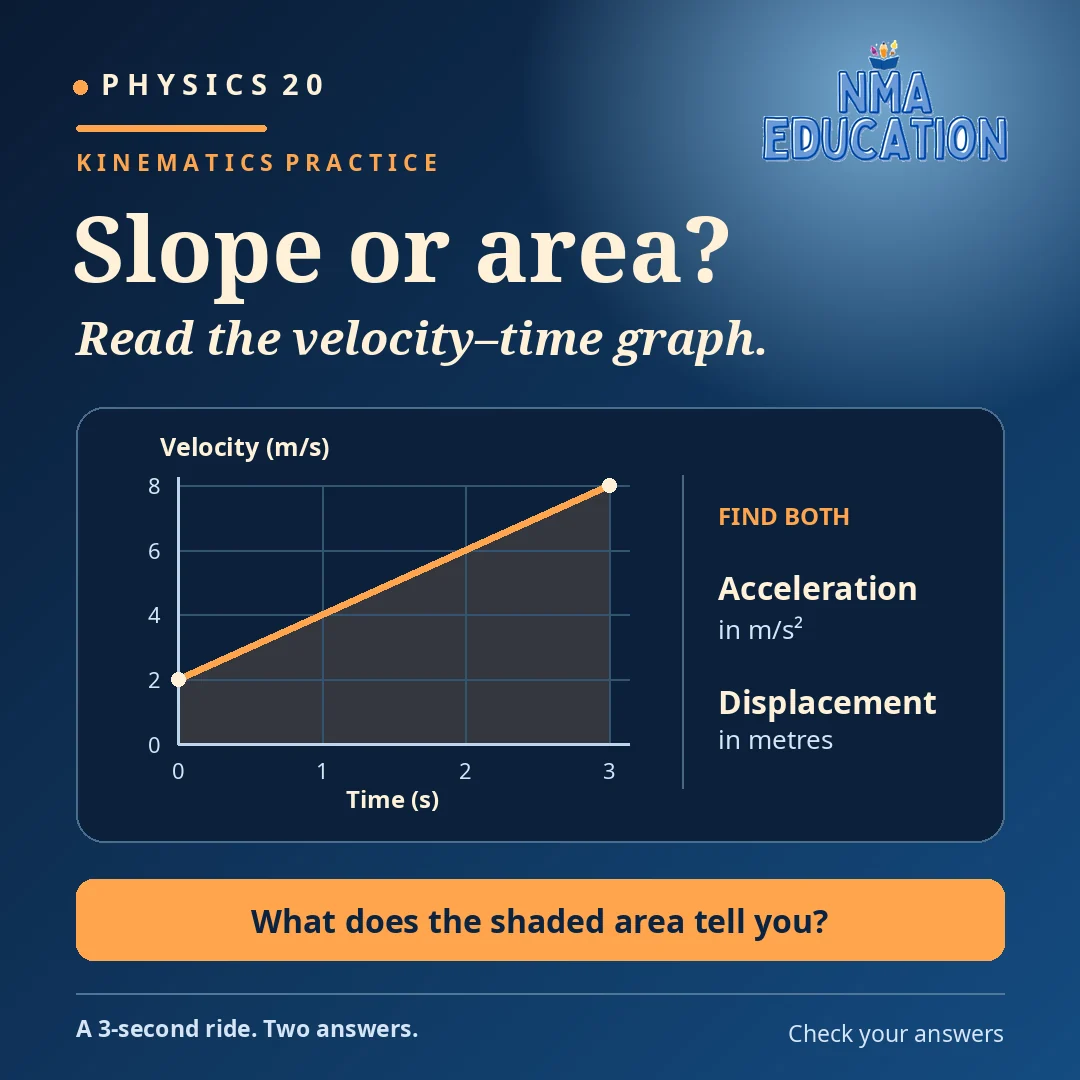
The slope gives acceleration. The signed area between the graph and the time axis gives displacement. Areas below the axis count as negative.
A cyclist’s velocity rises steadily from +2 m/s to +8 m/s over 3 seconds. Work out the acceleration and displacement, then open each answer to check your reasoning.
Divide the change in velocity by the time interval. (+8 − 2) m/s ÷ 3 s = +2 m/s².
The area is a trapezoid. Its average height is (2 + 8) ÷ 2 = 5 m/s. Multiply by 3 s to get +15 m.
Velocity falls steadily from +4 m/s at 0 s to −4 m/s at 4 s. Each triangle has area ½ × 2 s × 4 m/s = 4 m. The two signed areas cancel, so displacement is 0 m. Add the magnitudes to find the distance travelled, 8 m.
A plan for the next assessment
For Physics 20, support can focus on school quizzes, unit tests and cumulative review. For Physics 30, we can also discuss diploma exam preparation using mixed problems, conceptual explanations and a review of common calculation errors. The preparation is shaped around the learner’s actual course and timeline.
The same personal attention
Focused, one-to-one support in a familiar setting. Share your area so we can discuss availability.
Request a library session for face-to-face learning. Meeting times and arrangements are confirmed together.
Work through concepts and questions interactively, with the convenience of learning from home.
We can practise rearranging equations, using scientific notation, reading graphs and keeping track of units as part of the physics lesson. We connect the calculation to its physical meaning.
Yes. Tell us the exam date and the topics that need attention. We can discuss concept review, mixed practice and feedback on the student’s approach.
Request in-person tutoring at your home in Edmonton or Riverbend Library (Terwillegar), or choose online. NMA confirms tutor availability and meeting arrangements before booking.
Let’s find your starting point
Tell us the course and what feels difficult. We’ll discuss a tutor match, preferred setting and availability.