Energy and matter in ecosystems
Use food webs to trace energy transfer and distinguish it from the cycling of matter.
In-person tutoring in Edmonton · Online too
Make sense of how living systems work.
Work one-to-one with an Alberta-certified teacher on your current unit, a school test or the Biology 30 diploma exam.
Expert, Alberta-certified teachers · Personalized, one-to-one lessons
Clear explanations. Purposeful practice.
Biology questions often ask you to explain what changes and why. We help students read diagrams and graphs, connect unfamiliar terms to processes they already know, and practise writing clear explanations.
Bring a diagram, lab question or marked quiz. We’ll work through it together, then try a similar question so you can practise applying the idea on your own.
Alberta curriculum support
Choose the course, then start with the topics that need attention.
Alberta Grade 11 biology, from ecosystems to human body systems.
Use food webs to trace energy transfer and distinguish it from the cycling of matter.
Use evidence to explain how natural selection can change a population over generations.
Compare how cells capture energy in sugars and release usable energy from them.
Connect digestion, respiration, circulation and excretion to the needs of cells.
Alberta Grade 12 biology with support for classwork and diploma exam preparation.
Follow a nerve signal and explain how hormones and feedback help regulate the body.
Connect reproductive hormones, fertilization and early stages of development.
Compare mitosis and meiosis, then apply inheritance patterns to crosses and pedigrees.
Interpret population growth graphs and explain how interactions and limiting factors affect populations.
Course topics informed by Alberta’s official curriculum documents ↗. We follow the learner’s current classwork and needs.
See the thinking
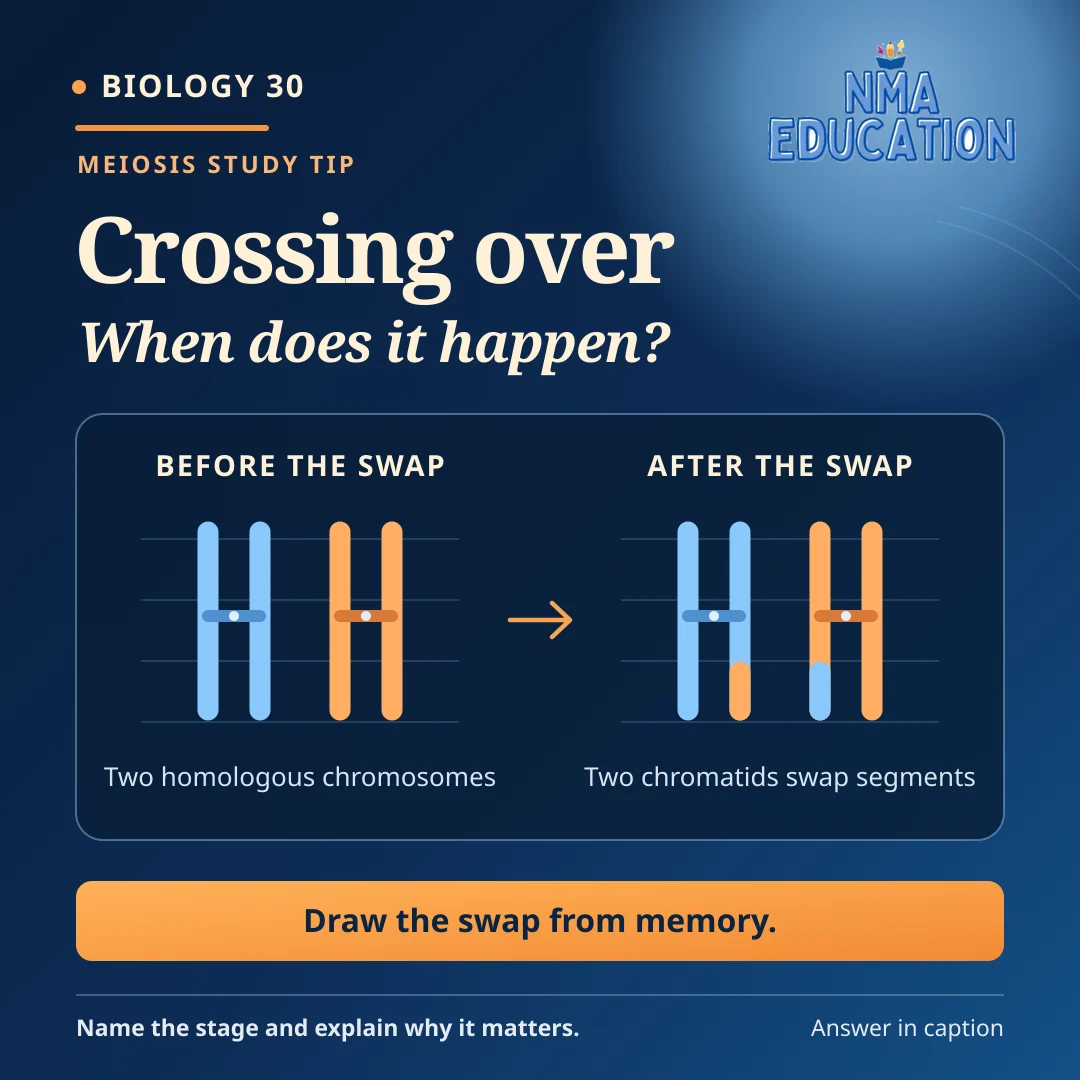
Use two colours to follow the chromosomes. Label the matching segments and point to the two non-sister chromatids that trade them.
Crossing over happens in prophase I and can increase genetic variation by creating new combinations of existing alleles.
Biology 30 · Molecular genetics · November 22, 2026
For this short practice sequence, the DNA template strand is 3′–TAC GGA ATT–5′. Write the complementary mRNA sequence from 5′ to 3′. Try it before revealing the checks.
Read the DNA template from 3′ to 5′; RNA is built from 5′ to 3′. For DNA → RNA pairing, use T → A, A → U, C → G and G → C.
RNA uses uracil (U) instead of thymine (T). The template and its RNA complement run in opposite directions.
TAC → AUG, GGA → CCU and ATT → UAA. The answer is 5′–AUG CCU UAA–3′.
Check every base and both end labels. Because the template is already written 3′ to 5′, pair across it as shown.
The complementary coding strand is 5′–ATG CCT TAA–3′. It matches the mRNA sequence except that DNA has T where RNA has U.
A template strand and a coding strand are different. Identify which one the question supplies before choosing your method.
Biology 20 practice
Use the pond food chain to compare energy stored at each trophic level. The energy values cover the same area and time period.
Divide the energy at the receiving level by the energy at the previous level. (1,200 ÷ 8,000) × 100 = 15%.
(120 ÷ 1,200) × 100 = 10%. The data give different percentages for the two steps.
(120 ÷ 8,000) × 100 = 1.5%. Some energy is released as heat during respiration. Some remains in material that isn’t eaten or digested.
A plan for the next assessment
For Biology 30 diploma preparation, we can use released questions to practise interpreting diagrams, tables and experimental results. We review why an answer fits the evidence and identify the next topic to practise.
The same personal attention
Focused, one-to-one support in a familiar setting. Share your area so we can discuss availability.
Request a library session for face-to-face learning. Meeting times and arrangements are confirmed together.
Work through concepts and questions interactively, with the convenience of learning from home.
Yes. Start with the unit you’re working on now, such as human systems in Biology 20 or genetics in Biology 30. Bring a question so we can see where you’re getting stuck.
Yes. We can discuss a review plan that combines your hardest topics with practice interpreting evidence and explaining your reasoning.
Yes. Request your Edmonton home, Riverbend Library (Terwillegar) or online tutoring. We confirm the location and tutor availability with you.
Let’s find your starting point
Tell us the course and what feels difficult. We’ll discuss a tutor match, preferred setting and availability.