
Good Math 30-1 diploma exam preparation begins with finding the gaps in your understanding. Review those skills, mix questions from different units, and practise explaining a complete solution. Use Alberta’s official materials alongside your classwork, then make time to revisit the questions you missed.
If revision currently means rereading a binder and hoping the steps will feel familiar on exam day, make the next session more specific. Choose one skill, attempt a question before checking the answer, and use the result to decide what to practise next.
Begin with the right materials
Keep your course outline, recent assessments and a short mistake log together. Alberta’s official diploma exam resources provide mathematics practice materials and links to the digital assessment platform. Practise using the official platform so its navigation and response-entry tools feel familiar. [1]
For your actual writing session, check the current subject bulletin, schedule and calculator rules linked from Alberta’s exam administration page. Confirm your arrangements with your school. A practice paper from an earlier year is useful mathematics practice; its old instructions may differ from your current session. [2]
As you review, include connections between functions and graphs, logarithms and exponential equations, trigonometric reasoning, and counting methods. The province’s assessment standards describe the course outcomes and examples of the expected thinking. Use your teacher’s course outline to keep the whole course in view. [3]
A four-week revision plan you can adapt
This is a suggested study routine, not an official exam schedule. If you have less time, keep the same sequence and narrow the number of topics.
- Week 1: find your starting point. Try a small mixed set before reviewing the solutions. Mark each difficulty as a concept gap, an algebra error, a misread instruction or a calculator issue. Pick two priorities for the next few sessions.
- Week 2: rebuild the difficult skills. Work through a clear example, attempt a similar question independently, then change one feature of the question. Check whether you can explain the method without copying the model.
- Week 3: mix the units. Alternate topics so you must choose the method yourself. Include algebraic work, graphs and written explanations. Return to a missed question in a later session and solve it from the beginning.
- Week 4: rehearse and refine. Complete a timed practice set using the instructions supplied with that resource. Review it carefully, then use shorter sessions to address recurring errors and confirm school instructions for the exam.
Before each study session, write a concrete goal such as “check restrictions in logarithmic equations” or “find every trigonometric solution in the stated interval.” At the end, record one thing that is clearer and one question to bring to class or tutoring.
Try three original Math 30-1 questions
These are NMA practice examples, not released diploma exam questions or a full practice exam. Try each one before opening its solution. They illustrate a few useful checking habits.
01 / Logarithms
Which algebraic answer is allowed?
Solve log₂(x − 1) + log₂(x + 1) = 3.
Show the logarithm solution
- Both logarithm arguments must be positive. The combined restriction is x > 1.
- Combine the logarithms: log₂[(x − 1)(x + 1)] = 3.
- Convert to exponential form: x² − 1 = 2³ = 8, so x² = 9.
- The algebra gives x = 3 or x = −3. Only x = 3 satisfies the restriction.
- Check: log₂2 + log₂4 = 1 + 2 = 3.
Checking habit: compare every candidate solution with the original equation and its restrictions.
02 / Trigonometric equations
Have you found every solution?
Solve 2 sin²θ − sinθ − 1 = 0 for 0 ≤ θ < 2π.
Show the trigonometry solution
- Treat sinθ as the variable and factor: (2 sinθ + 1)(sinθ − 1) = 0.
- Therefore sinθ = −½ or sinθ = 1.
- On the stated interval, sinθ = 1 at θ = π/2.
- The reference angle for sinθ = −½ is π/6. Sine is negative in quadrants III and IV, giving θ = 7π/6 and θ = 11π/6.
- The complete answer is π/2, 7π/6 and 11π/6. Each value belongs to the interval.
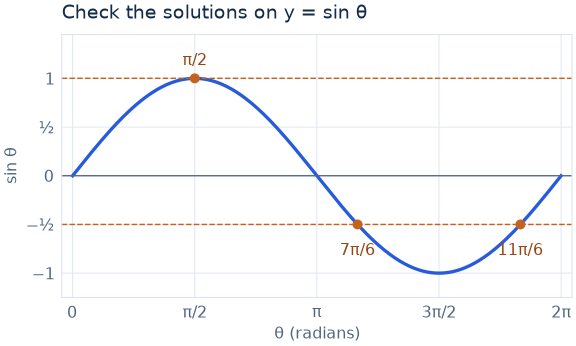
Checking habit: note the angle units and interval before you start, then check that your answer is complete.
03 / Function transformations
What happens to a point?
The point (2, 4) is on y = f(x). Find its corresponding point on g(x) = −2f(x − 3) + 1.
Show the transformation solution
- The original input is 2. Set x − 3 = 2, so the new input is x = 5.
- The original output is 4. The new output is −2(4) + 1 = −7.
- The corresponding point is (5, −7).
Checking habit: work with the input inside the function and the output outside it separately. Then check by substitution.
Make a mistake log that changes your next attempt
“Be more careful” is difficult to act on. Record the exact step that went wrong and a specific check to use next time.
| Question type | What went wrong? | My next check |
|---|---|---|
| Logarithmic equation | I kept an answer outside the domain. | Write restrictions first and test the final answers. |
| Trigonometric equation | I found only one angle. | Use the interval and all relevant quadrants. |
| Transformed function | I moved the point in the wrong direction. | Solve for the new input, then calculate the output. |
For written work, show the equations and reasoning that connect your steps. Alberta publishes a dedicated written-response resource; use it with your teacher’s feedback when reviewing how clearly you communicate a solution. [4]
Before the final practice session
- Confirm your exam date, location, start time and writing arrangements with the school.
- Check the current official calculator rules and ask the school about the permitted configuration.
- Practise reading instructions, entering responses and checking the requested units or rounding.
- Choose a manageable final review from your mistake log, rather than trying to relearn every unit at once.
Common preparation questions
When should I start revising?
Start while there is time to identify a gap, get help and revisit the skill. The four-week plan above is one way to organise that process. Adjust it to your school workload and the time available.
Should I keep doing full practice papers?
Use a full or timed set to find patterns in your work, then leave time to review it. If the same skill keeps causing trouble, spend a session rebuilding that skill before attempting another long set.
What should I bring to an exam-preparation lesson?
Bring a recent assessment, the questions you attempted, your working and a short list of recurring difficulties. That gives the tutor a clearer starting point than a general request to review everything.
Official resources and further reading
Resource links checked November 10, 2026. Use Alberta’s current bulletin and school instructions for your exam session. NMA’s study routine and practice examples are independent teaching resources.