
Math 20-1 normally leads toward Math 30-1 and calculus-related pathways. Math 20-2 normally leads toward Math 30-2 and programs that do not require calculus. The choice should reflect the student’s goals, current understanding and the requirements of the programs they may apply to. [1]
After Math 10C, a course-selection form can make the decision look like a simple choice between two numbers. For families, the useful question is more specific: which route supports the learner’s next step, and what help would make that route manageable? Start with the school’s advice and the student’s actual work.
Math 20-1 and Math 20-2 at a glance
Both courses build on Math 10C. Their usual Grade 12 destinations differ, and they place different emphasis on the mathematics students use. This is a pathway comparison, rather than a promise of admission to any particular program. [1][2]
| Compare | Math 20-1 | Math 20-2 |
|---|---|---|
| Starting point | Math 10C | Math 10C |
| Usual next course | Math 30-1 | Math 30-2 |
| Learning focus | Algebra, functions and trigonometric reasoning | Reasoning, geometry, data interpretation and algebra |
| Future planning | A route toward programs requiring calculus-related preparation | A route toward programs that do not require calculus |
Check the exact Grade 12 course and minimum-mark requirements with each post-secondary institution. A general course description does not replace a program’s admission requirements.
What does each course focus on?
Math 20-1: connecting algebra and functions
Common work includes quadratic functions and equations, trigonometry, radical and rational expressions, and sequences and series. These topics ask students to move between expressions, equations, graphs and explanations. [3]
A useful preparation question is: can the student explain an algebraic step, check it, and use it in a slightly unfamiliar question? If factoring or manipulating expressions is slow, a focused review can help identify what to practise alongside the new unit.
Math 20-2: reasoning, relationships and interpretation
Students work with proportional reasoning, geometry and triangles, logical arguments, radicals, statistical information and quadratics. It still involves algebra and trigonometry; reasoning clearly is part of the work. [2]
Practise deciding what a question is asking, choosing a method and describing why the result makes sense. Being comfortable with a calculator helps, but a numerical answer alone may leave important thinking unexplained.
A shared skill: connect equations and graphs
One example cannot define the difference between two courses. Quadratic work does, however, show why understanding connections matters. Try solving this question and then explaining the graph.
Solve x² − 5x + 6 = 0. How does the graph confirm the answer?
- Find two numbers with a product of 6 and a sum of −5: −2 and −3.
- Factor the equation: (x − 2)(x − 3) = 0.
- For the product to be zero, one factor must be zero. Therefore x = 2 or x = 3.
- The graph of y = x² − 5x + 6 meets the x-axis at those same values, where y is zero.
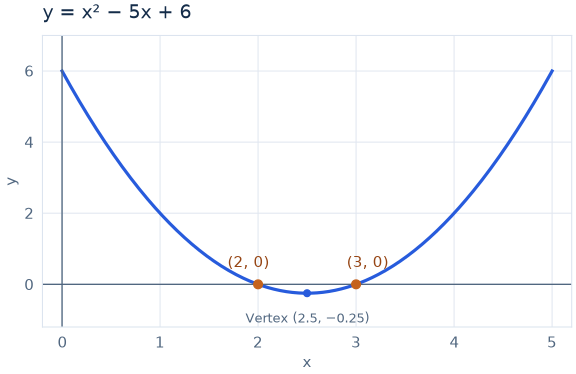
Ask the learner to check each solution in the original equation. Then change a coefficient and discuss what might change on the graph. That conversation often reveals more than simply asking whether the answer was correct.
Math 20-1 practice
How to solve an absolute value equation
Absolute value measures distance from zero. Both 7 and −7 are 7 units from zero, so the expression inside the absolute value bars can take either value.
Solve |2x − 5| = 7. Find and check both solutions.
Show both equations
If 2x − 5 = 7, then 2x = 12 and x = 6. If 2x − 5 = −7, then 2x = −2 and x = −1.
Check both solutions
For x = 6, |12 − 5| = |7| = 7. For x = −1, |−2 − 5| = |−7| = 7. Both satisfy the original equation.
What if the right side is zero or negative?
For |2x − 5| = 0, set 2x − 5 = 0 to get one solution, x = 5/2. For |2x − 5| = −7, there is no solution because a distance cannot be negative.
Five questions to ask before choosing
- Which Grade 12 math course might I need? Look at the actual programs under consideration, including any calculus requirement.
- Which Math 10C skills are secure? Bring a marked quiz or a few questions to the teacher, rather than relying only on an overall percentage.
- Where do I get stuck? Distinguish a missing prerequisite, a problem interpreting questions, and a difficulty organising practice.
- What study routine is realistic? Consider other courses and commitments, then plan manageable practice between lessons.
- What happens if my plans change? Ask the school counsellor about additional courses, timing and the school’s transfer arrangements.
Changing direction can involve extra steps. For example, Ardrossan Junior Senior High describes a pathway through Math 20-2 and Math 30-2 to Math 30-1. Your school must confirm the route available to you and how it fits your timetable. [4]
Common family questions
Is Math 20-2 always easier?
Students can find different parts of the courses challenging. Math 20-2 includes algebra, trigonometry and reasoning. Compare the course focus with the student’s understanding and future requirements, and discuss readiness with the school.
Is Math 20-1 a calculus course?
No. It is part of the pathway toward Math 30-1. Math 31 introduces calculus, with Math 30-1 as a prerequisite or corequisite. Confirm course scheduling with the school. [2]
What if my child is already struggling?
Start with a recent assessment and the current unit. Identify a small number of recurring difficulties, then ask the teacher what to prioritise. Tutoring can address those gaps alongside current classwork; a course change is a separate conversation with the school.
Sources and further reading
Course information checked November 9, 2026. These school sources describe their own offerings. Confirm placement, transfers and post-secondary requirements with the relevant school or institution.